
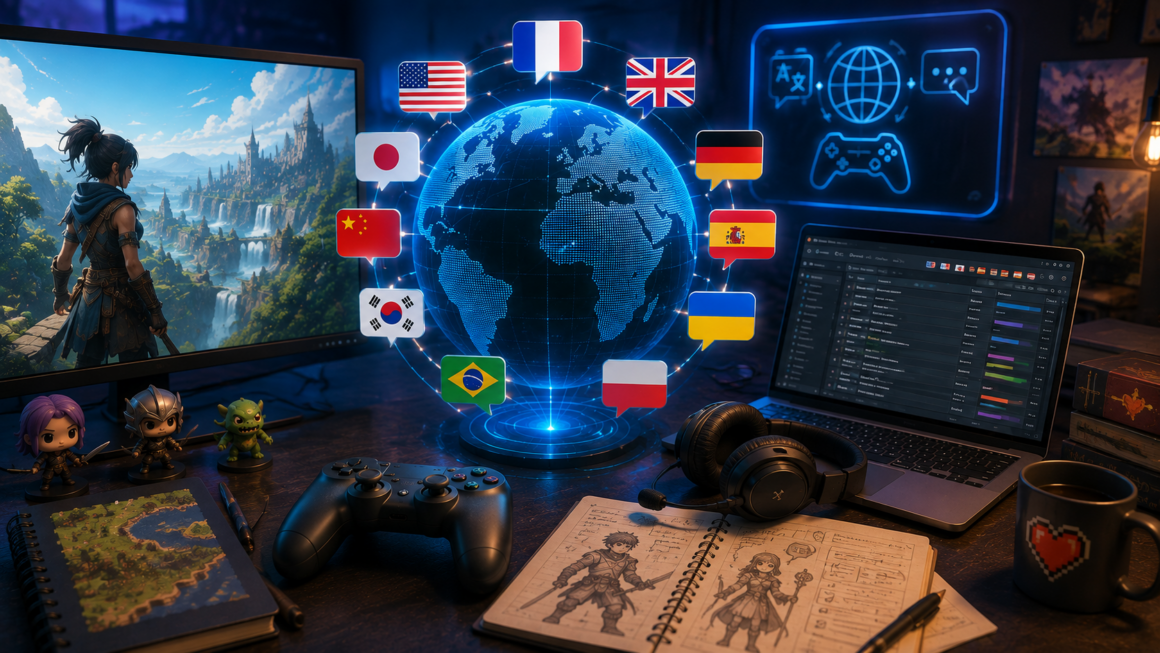
Key Takeaway: The best services for translating video games in 2026 combine specialized game localization workflows with cultural consultation, engine integration, and voice-over coordination. Eight providers consistently deliver production-grade capability, each fitting different studio profiles from indie to AAA.
TL;DR: Video game translation is a specialized discipline that requires more than word-for-word conversion – it demands cultural adaptation, technical integration with game engines, in-context editing, linguistic quality assurance, and often voice-over coordination. The best providers in 2026 include Crowdin, Keywords Studios, Altagram, LocalizeDirect, Side Global, Lokalise, PTW, and Level Up Translation. Choosing among them depends on studio size, game genre, target markets, and whether voice-over is in scope.
Global game markets in 2026 look dramatically different from a decade ago. Four out of the top five gaming markets by revenue are non-English – China, Japan, South Korea, and Germany – and international revenue often exceeds domestic revenue for successful indie and AAA titles alike. Studios that treat localization as a launch-week task consistently underperform in these markets. Studios that build translation into production from day one consistently outperform.
The category of professional game translation services has matured accordingly. What used to be a niche of generalist agencies doing occasional game work is now a specialized industry with platforms, full-service agencies, and hybrid providers each serving distinct segments of the market. This guide profiles the top translation video games tools and services available in 2026, describes what game translation looks like as a modern service offering, and helps studios match their operational profile to the right provider.
What Game Translation Is as a Modern Service
Game translation is a specialized layer of localization that extends far beyond text conversion. Modern providers deliver an integrated stack of capabilities:
- Text translation for dialogue, UI, item descriptions, tutorials, and store copy
- Cultural adaptation (culturalization) for symbols, humor, gestures, and narrative references
- Voice-over coordination for character dialogue and cinematic audio
- In-context editing so translators see strings in the actual game UI
- Linguistic Quality Assurance (LQA) with native testers playing the localized build
- Engine integration for Unity, Unreal, Godot, and custom engines
- Continuous localization workflows for live-service and regularly updated titles
- Regulatory compliance for age rating boards (ESRB, PEGI, CERO, USK)
Game translation services suit indie studios shipping their first international release, mid-size studios adding new languages continuously, and AAA publishers coordinating text and voice localization across dozens of markets. Each provider profiled below fits a different subset of these needs.
Top 8 Services for Translating Video Games in 2026
1. Crowdin
Delivered as a managed service, Crowdin tool for translation video games packages multiple neural translation engines, translation memory, glossary management, in-context editing, and continuous integration workflows into a single platform. The service supports Unity, Unreal, Godot, and cross-platform frameworks natively, with over fifty file formats and integrations with GitHub, GitLab, Bitbucket, Figma, and dozens of other systems used by modern game teams.
Best fit: studios of any size shipping in multiple languages on continuous release cadences. Strong choice for teams that want both platform tooling and access to a translator marketplace in one place. Free tier available for small projects; enterprise plans include SSO and dedicated support.
2. Keywords Studios
Keywords Studios is the largest specialized game services provider globally, offering end-to-end localization including translation, voice-over recording, cultural consultation, and LQA under a single vendor relationship. Its scale allows it to handle AAA release calendars across 40+ languages simultaneously.
Best fit: AAA publishers and mid-to-large studios that want a single accountable partner across the full localization stack. Higher price point that requires substantial project volume to justify.
3. Altagram
Altagram is a specialized game localization agency with offices in Berlin, Montreal, Seoul, and Tokyo. It handles text translation, voice-over production, cultural consultation, and LQA across a wide range of game genres.
Best fit: mid-size studios that want game-specialist expertise without full AAA-scale overhead. Particularly strong on European and Asian language pairs.
4. LocalizeDirect
LocalizeDirect, based in Sweden, specializes in games and offers its LocDirect platform alongside professional translation services. The company has particular strength in the indie and mid-tier segments and integrates directly with Unity and Unreal.
Best fit: indie and mid-size studios that want game-focused platform tooling with the option of managed translation services. Strong Asian-language coverage.
5. Side Global
Side Global specializes in voice-over production for games, with recording studios in multiple regions and casting networks across major languages. The company handles English original recording and localized voice production for AAA and mid-tier titles.
Best fit: studios with significant voice-over needs across multiple languages. Often paired with a separate text translation provider for full-stack coverage.
6. Lokalise
Lokalise is a developer-friendly translation management system that has grown steadily in the game industry. It offers Git integration, in-context editing, and mobile SDKs, making it a common choice for mobile-first game studios.
Best fit: mobile game studios and small-to-mid indie teams that value developer workflow polish over full-service managed operations.
7. Pole to Win (PTW)
PTW is a global game services provider offering translation, voice-over, QA, and community management. With deep Japanese-market expertise and significant Western presence, it handles Japanese-to-English and English-to-Japanese localization at scale.
Best fit: studios with significant Japanese-market focus or those requiring the largest global service footprint alongside Keywords Studios.
8. Level Up Translation
Level Up Translation is a boutique specialist focused on indie and mid-tier games. The company handles text translation with strong culturalization expertise and works closely with small studios throughout development.
Best fit: indie studios seeking specialist attention and cultural expertise without full-service agency overhead. Often used for narrative-heavy titles.
Best Practices for Choosing a Game Translation Service
Structured evaluation consistently outperforms proposal comparison. When selecting a provider, follow these patterns:
- Define scope precisely. Text-only, text plus voice-over, or full localization with cultural consultation and LQA – each scope produces different vendor shortlists.
- Match provider archetype to your studio profile. Full-service agencies fit AAA and mid-size studios. Platform-first providers fit teams with internal localization capacity. Boutique specialists fit narrative indie titles.
- Run paid pilots on real production content. Vendors that resist paid pilots are almost always the wrong choice.
- Verify game engine integration depth. Native Unity or Unreal support saves months of engineering time compared to generic API workflows.
- Negotiate translation memory ownership explicitly. Your language assets must remain portable in TMX and TBX formats.
- Include LQA in the initial contract. Studios that add LQA later routinely underinvest in the discipline.
- Test cultural consultation capability. Ask for specific examples of past culturalization decisions the provider has made for markets similar to yours.
Frequently Asked Questions
What is the difference between game translation and game localization?
Game translation is the conversion of text from one language to another. Game localization is the broader adaptation of the entire game – text, audio, cultural references, regulatory compliance, marketing – for a specific market. Every localization project includes translation, but not every translation project is a full localization.
How much does professional game translation cost?
Indie games with 30,000-50,000 words typically budget $5,000-$30,000 per language for text-only translation. AAA titles with hundreds of thousands of words and voice-over can reach $150,000-$2 million per language. Machine translation with human post-editing significantly reduces costs for routine content.
Which languages should indie studios prioritize?
The five languages with consistently strong ROI for indie games are Simplified Chinese, Brazilian Portuguese, Latin American Spanish, Russian, and German. Japanese and French follow closely for narrative-heavy titles.
Can AI handle game translation on its own?
Not for narrative content. AI translation has improved dramatically and handles routine content – UI strings, help articles, item descriptions – with high accuracy. Character dialogue, emotional beats, and culturally sensitive material still benefit substantially from human translators and cultural consultants. The dominant model in 2026 is AI-first drafting with human refinement.
What should indie studios look for in translation video games tools and services?
Look for game engine integration, translation memory as a standard feature, in-context editing, LQA workflow, cultural consultation capability, portable data ownership, and pricing that scales with your release cadence.
How long does game translation take?
For a small-to-mid indie game with 30,000-50,000 words across five languages, expect 4-8 weeks with continuous localization workflows. Larger narrative titles with full voice-over across ten or more languages can require 4-8 months.
Conclusion
The market for game translation services in 2026 offers legitimate differentiation across specialist agencies, platforms, and hybrid providers. Crowdin, Keywords Studios, Altagram, LocalizeDirect, Side Global, Lokalise, PTW, and Level Up Translation each fit different operational profiles. The right choice depends on your studio’s scale, game genre, target markets, and whether voice-over is in scope.
Studios that treat provider selection as infrastructure planning – running paid pilots, evaluating against real criteria, and negotiating for translation memory ownership – build partnerships that support them across multiple releases. Those that treat it as procurement regret the choice within a year. Choose deliberately, and let the results of a structured pilot guide the final decision.