
The way people create is changing. In the past, bringing a creative idea into the physical world often required professional skills, expensive tools, and a long production process. Today, artificial intelligence is making creation more accessible, allowing more people to transform their imagination into digital content and physical objects.
3D creation is one of the fields experiencing this transformation. From character design and personalized collectibles to product concepts and creative projects, more creators are exploring how AI and 3D printing can work together.
However, creativity is not limited by ideas. It is often limited by the tools needed to realize those ideas. Many artists and creators have strong visual concepts but lack traditional 3D modeling experience. Turning a sketch, image, or imagination into a complete 3D model can still be challenging.
Hi3D is designed to shorten this distance between imagination and creation. By combining AI-powered model generation, texture creation, and printing preparation tools, Hi3D helps creators explore 3D design in a simpler and more efficient way.
With the official launch of Hi3D V3.0, AI 3D creation reaches a new level. The latest version improves model accuracy, structural understanding, texture quality, and production usability, helping creators move beyond simple concepts and build more complete 3D worlds.
1. The New Creative Era: When Anyone Can Explore 3D Design
The development of digital creation tools has always focused on making creativity easier to achieve. From digital painting software to AI image generation, technology continues to reduce the gap between ideas and final results.
The same change is now happening in 3D creation.
1.1 The Traditional Barriers Behind 3D Creation
For many creators, 3D modeling has always seemed difficult to approach.
Unlike traditional drawing or design, creating a 3D object requires understanding multiple aspects, including geometry, structure, materials, and optimization. Even creators with strong artistic abilities may struggle when they first enter the 3D workflow.
This creates a common situation: creators have ideas but cannot easily turn them into three-dimensional objects.
A character designer may imagine a new figure but lack modeling skills. An illustrator may create beautiful artwork but find it difficult to transform it into a physical collectible. A product creator may have a concept but needs additional technical support to visualize it in 3D.
AI-powered creation tools are changing this process by allowing creators to start from their existing ideas instead of building everything manually.
1.2 AI Is Becoming a Creative Partner
The purpose of AI in creative industries is not simply replacing traditional methods. Instead, AI provides new possibilities for exploration.
Creators can use AI to quickly test concepts, generate early versions, and discover new directions.
Hi3D follows this approach by helping users transform creative input into 3D models while keeping the creator’s original ideas at the center of the process.
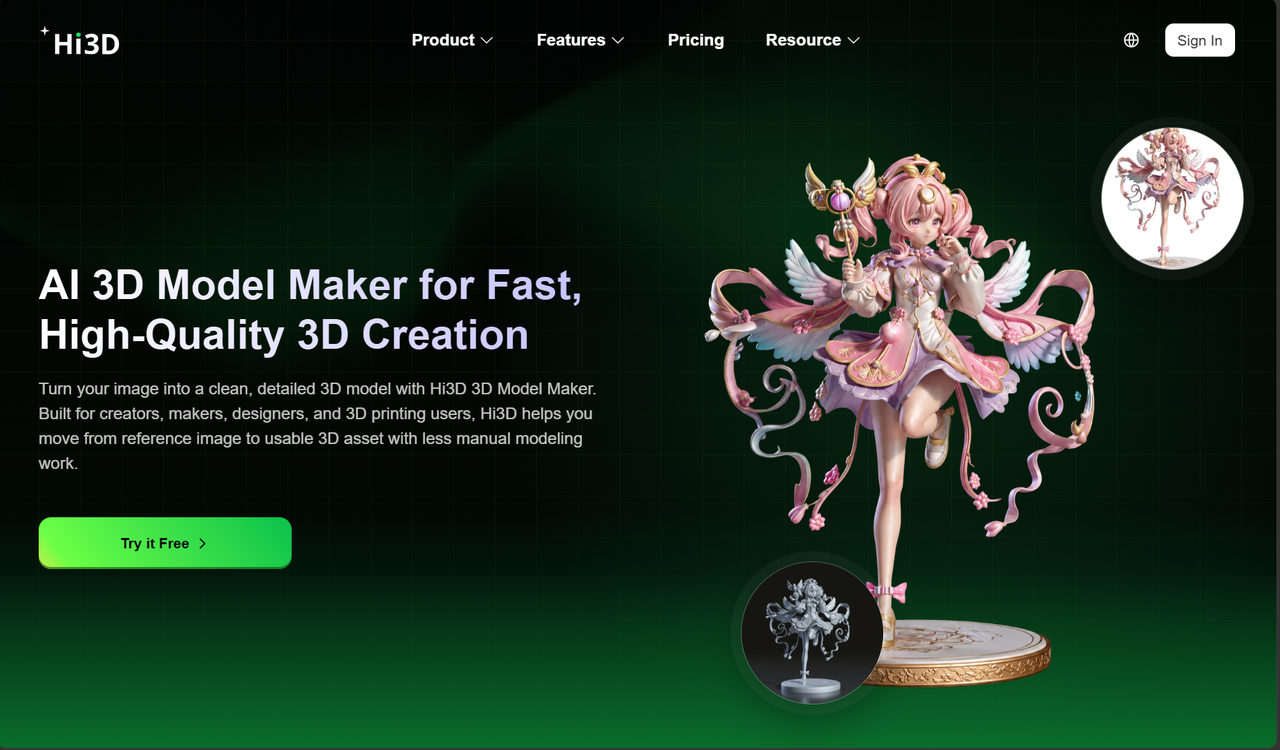
As an AI 3D model maker, Hi3D provides a bridge between imagination and production, allowing more creators to participate in 3D design.
2. Helping Creators Transform Images into 3D Experiences
Images are often the first expression of creativity.
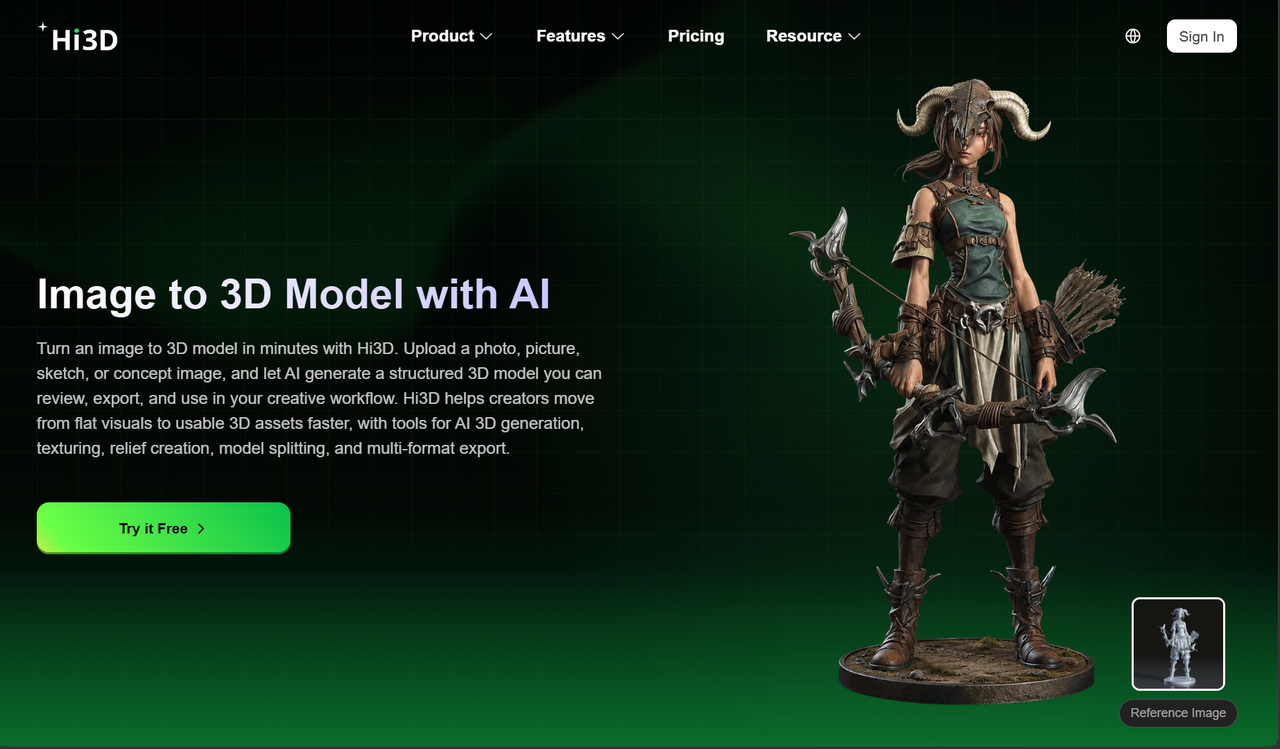
A drawing, illustration, product image, or personal picture can contain the foundation of a creative project. However, converting a two-dimensional image into a three-dimensional object traditionally requires complex modeling work.
Hi3D makes this transformation easier through AI-based generation.
2.1 From Visual Inspiration to 3D Models
A single image contains valuable information about appearance, shape, and style. The challenge is understanding how these elements should exist in three-dimensional space.
Hi3D helps creators transform visual references into 3D models, allowing them to explore new creative possibilities without starting from complicated modeling software.
With photo to 3D model, creators can use existing images as the foundation of a 3D project. This provides a faster way to develop characters, creative objects, product concepts, and personalized designs.
For artists, this means their 2D creations can enter a new dimension.
For designers, it provides a faster method to test early concepts.
For beginners, it creates a more approachable way to experience 3D creation.
2.2 Creating New Possibilities from Simple Ideas
Creative projects do not always begin with finished artwork.
Sometimes the first step is simply an idea.
A creator may imagine a unique character, a fantasy object, or a personalized product but have no existing 3D reference.
Hi3D allows users to explore these concepts through AI generation, making it possible to move from imagination to a visible 3D result.
For users looking for a 3D model maker free experience, AI-assisted creation provides an easier entry point into 3D design without requiring advanced technical knowledge.
3. AI Texture Generation Gives Digital Creations More Personality
A 3D model is not complete only because it has the correct shape.
Surface details, colors, and materials play an important role in defining the identity of an object. This is especially true for creative fields such as character design, collectibles, digital art, and personalized products.
However, texture creation has traditionally been one of the more technical parts of 3D production.
3.1 Why Texture Matters in Creative Projects
A model without texture may appear unfinished. The same shape can create completely different impressions depending on its colors, patterns, and surface details.
For creators, adding these elements manually can require additional software knowledge and significant time.
This is where AI texture generation creates new opportunities.
3.2 Making Texturing Easier with AI
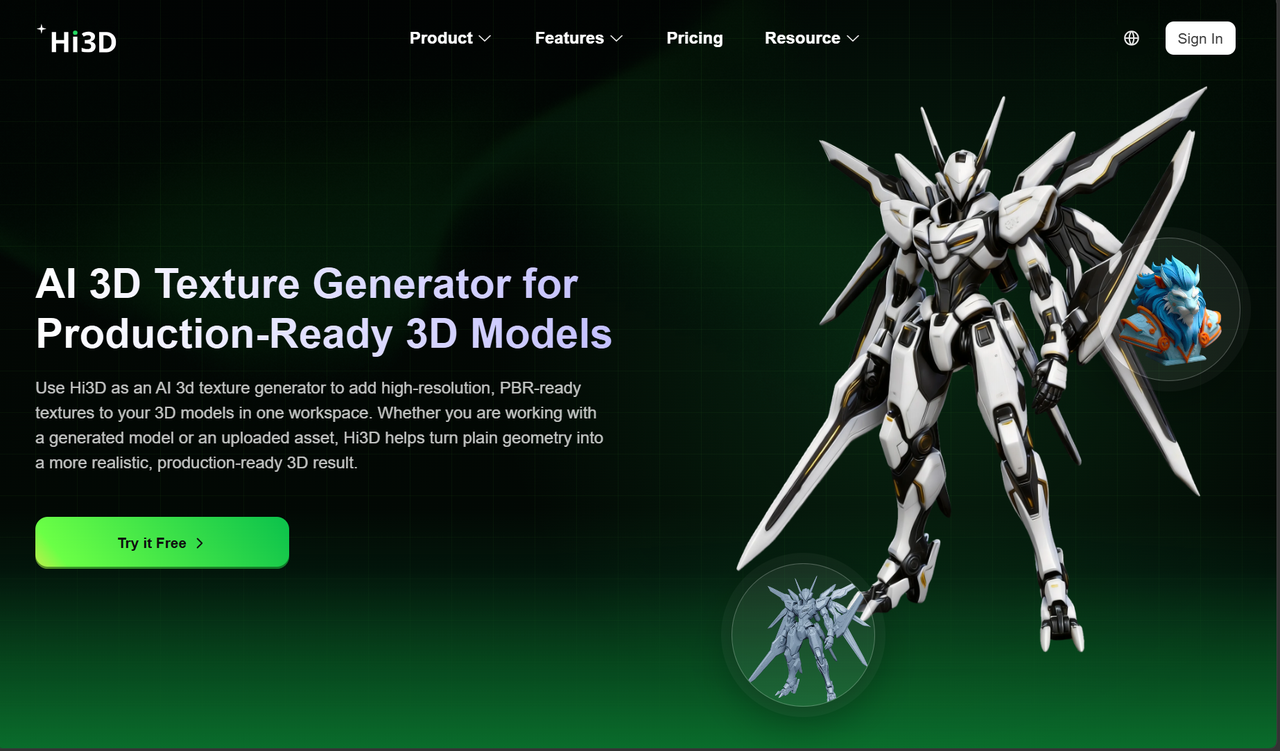
Hi3D helps simplify this process through AI-powered texture creation.
The AI texturing capability allows creators to generate visual details for their models more efficiently. Instead of manually designing every surface element, users can use AI assistance to create textures that match the overall style of the model.
This is particularly useful for creators working on:Character figures.Creative collectibles.Product concepts.Artistic models
By reducing technical workload, creators can spend more time developing ideas and improving the overall creative direction.
4. Hi3D V3.0: A Major Upgrade for Creator-Focused AI 3D Creation
The release of Hi3D V3.0 represents an important step forward for creators who want higher-quality AI-generated models.
Earlier AI 3D tools mainly focused on making generation possible. However, creators increasingly need models that are accurate enough for further editing, presentation, and production.
Hi3D V3.0 focuses on improving these areas.
4.1 Higher Detail with 2048³ Voxel-Level Reconstruction
One of the biggest upgrades to Hi3D V3.0 is the improvement of geometric reconstruction.
The new version increases reconstruction resolution to 2048³ voxel-level and becomes the first commercially available AI 3D model with this level of high-precision capability.
For creators, higher reconstruction accuracy means their ideas can be represented with more details.
Fine structures, small design elements, surface changes, and complex shapes can achieve clearer results. This helps reduce the difference between the original concept and the generated 3D model.
For creative projects where small details matter, this improvement can significantly influence the final result.
4.2 More Stable Results from Different Angles
A common challenge in AI-generated 3D models is maintaining consistency across different viewpoints.
A model may look correct from one perspective but contain problems in hidden areas.
Hi3D V3.0 improves cross-view structure reasoning, helping generated models maintain stronger consistency from multiple angles. This allows creators to work with more reliable 3D assets.
For character creators and product designers, this means models are easier to evaluate, modify, and prepare for further use.
4.3 Better Texture Quality with 8K Output
Visual quality is another major focus of Hi3D V3.0.
The new version improves texture generation by increasing output capability up to 8K resolution and upgrading its self-developed UV completion algorithm. These improvements enhance texture clarity, detail preservation, and overall surface quality.
For creators who rely on visual details, better textures help bring digital ideas closer to the original imagination.
5. Supporting Creators from Digital Design to Physical Printing
Creating a 3D model is only one part of the journey.
Many creators ultimately want to transform their digital designs into physical objects. To support this process, Hi3D provides additional workflow features.
5.1 Multi-Color Printing for More Creative Results
Color is an important part of many creative projects.
Hi3D’s multi-color printing capability helps convert textured AI models into printable multi-color objects. It improves the connection between digital textures and physical materials, helping creators produce more expressive printed results.
This is especially valuable for figures, customized products, and collectible designs.
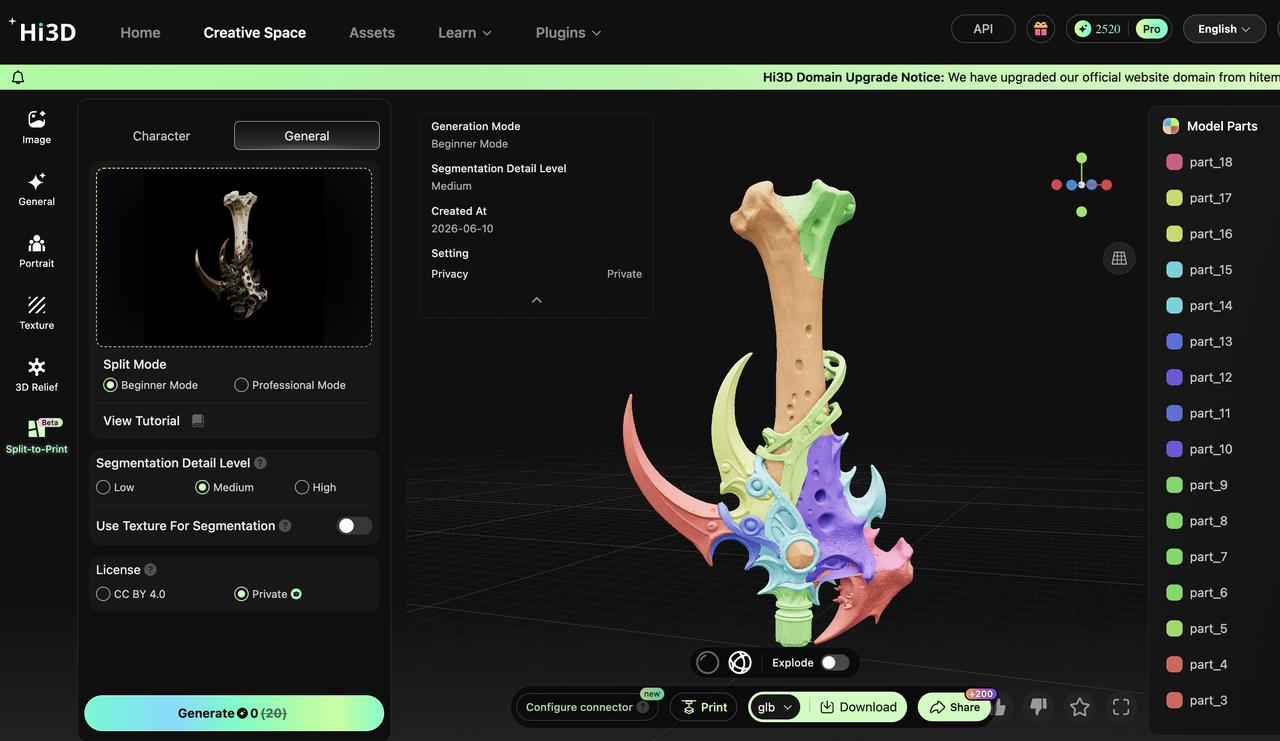
5.2 Split-for-Printing Simplifies Complex Models
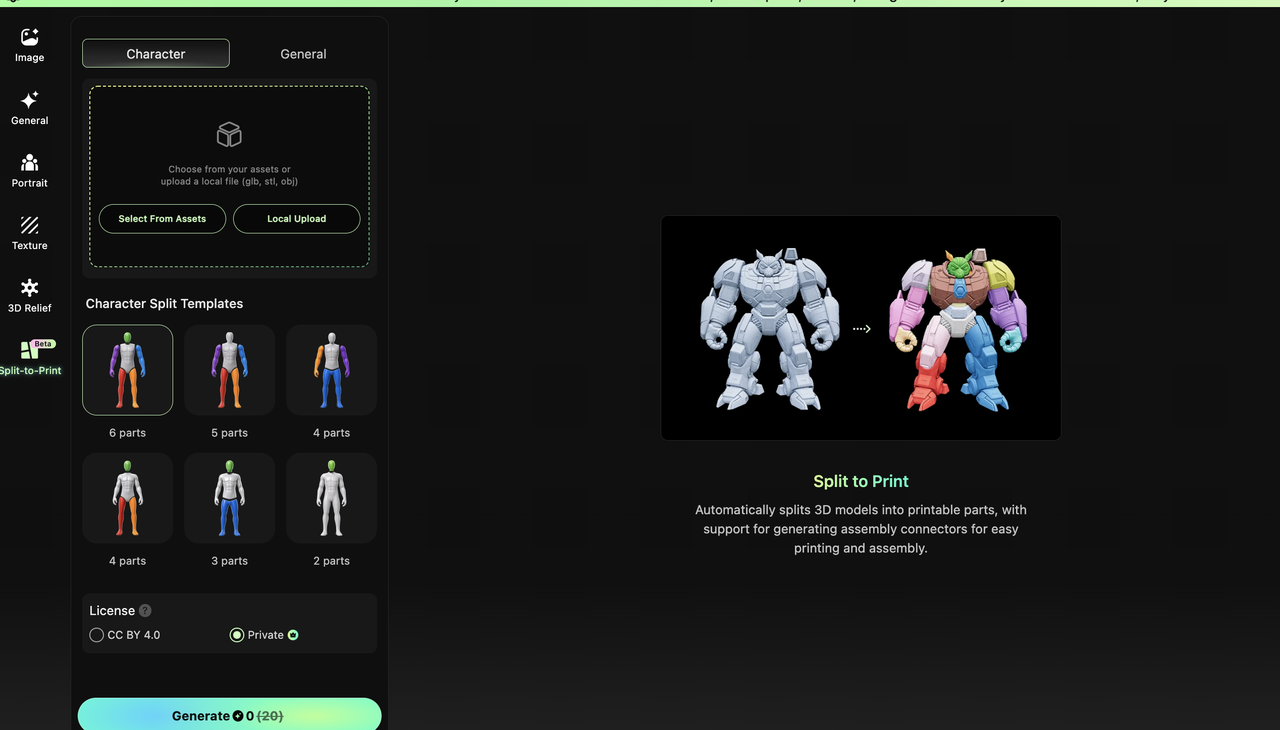
Some creative models contain multiple parts or complex structures that are difficult to print directly.
Hi3D’s split-for-printing feature helps divide models into suitable printable sections and generate connectors for easier assembly.
This allows creators to prepare larger or more detailed projects more efficiently.
5.3 Smart Arrangement Improves Printing Preparation
Before printing, creators need to consider model placement and printing settings.
Hi3D’s smart arrangement function helps organize models and improve preparation efficiency by suggesting better arrangements and export settings.
These features help creators focus more on designing rather than handling complicated preparation steps.
|
|
|
6. From Hi3D V1.0 to V3.0: Building a Better Creative Platform
The development of Hi3D reflects the continuous evolution of AI 3D technology.
Each version has focused on improving different parts of the creative process.
Hi3D V1.0 introduced commercial AI image-to-3D generation capabilities and improved the accessibility of AI-powered 3D creation.
Hi3D V2.0 expanded the workflow by combining geometry generation with texture capabilities, creating a more complete approach to AI 3D production.
Hi3D V3.0 continues this development by improving reconstruction accuracy, structural understanding, texture quality, and practical workflow features. The update also includes improvements related to intelligent splitting, multi-color printing, and smart arrangement.
This evolution shows that AI 3D technology is moving from simple model creation toward a complete creative ecosystem.
6.1 Expanding Creative Possibilities Across Industries
The impact of AI 3D creation is not limited to individual creators.
Many industries are exploring faster and more flexible ways to develop 3D assets.
In gaming, digital art, product design, education, jewelry, collectibles, e-commerce, and 3D printing, creators need tools that can transform ideas into usable models more efficiently.
Hi3D V3.0 supports this growing demand by providing a more complete AI 3D workflow that connects creativity with practical applications.
By lowering the technical barrier, Hi3D allows more people to participate in the future of 3D creation.
7. Experience Hi3D V3.0 with 48-Hour Free Access
The official launch of Hi3D V3.0 provides creators with a new opportunity to explore AI-powered 3D creation.
To celebrate the release, Hi3D offers a 48-hour free experience period where users can try Hi3D V3.0 without generation limits.
During this period, creators can explore AI model generation, AI texture creation, and printing preparation features freely.
After the 48-hour free experience ends, Hi3D will also provide a 70% discount promotion, making it easier for more users to continue their AI 3D creation journey.
From a simple idea to a complete 3D creation, Hi3D V3.0 is helping creators bring more imagination into the physical world.
The future of 3D design is becoming more open, and AI is giving more people the ability to create without limits.