

The Rust economy functions more like a high-stakes commodities exchange than a standard video game shop. Unlike other titles, items maintain high floor values due to their unique utility, such as glowing iron sights or biome-specific camouflage, and a “limited-run” store model that creates permanent scarcity. For those looking to sell Rust skins for real money, this environment offers a rare opportunity to convert in-game progression into tangible wealth.
For the savvy trader, the goal is to bridge the gap between virtual assets and tangible wealth. While the Steam Community Market is convenient, it is a “walled garden” where profits remain trapped as platform credit. True profitability requires navigating third-party marketplaces that facilitate real-world withdrawals via bank transfers, cryptocurrency, or digital processors, effectively turning a hobby into a viable financial strategy.
Success in this space demands a fundamental shift in perceiving value. The “Golden Rule” is that an item’s worth is never fixed; it is a fluid calculation determined by platform liquidity. A skin is only worth what a buyer is willing to pay in withdrawable cash, not its listed price on Steam. Real profit is found at the intersection of high-demand items and platforms with the active buyer volume necessary to convert pixels into cold, hard cash.
Choosing Your Marketplace (The Infrastructure)
To truly scale a skin-selling operation, you must treat your choice of platform with the same scrutiny a day trader treats a brokerage. The infrastructure you choose is the single most important factor in determining your actual take-home pay. Below is a deep dive into the mechanics of the Rust marketplace landscape.
Steam Community Market
The Steam Community Market (SCM) is the most deceptive environment for a profit-seeking trader. While it boasts the highest liquidity and the simplest user interface, it is fundamentally a “dead end.” Every dollar earned on Steam is essentially “Valve Credit”, it can never be legally withdrawn as cold hard cash.
Furthermore, the combined Steam and Game Developer fees total a staggering 15%. If you sell a high-tier skin like a Big Grin for $800, you are effectively lighting $120 on fire just for the privilege of having $680 trapped in a digital wallet. For those looking for “Real Money” strategies, the SCM should only be used as a price-tracking tool or a place to dump low-value “trash” skins that aren’t worth the withdrawal minimums on third-party sites.
Third-Party Titans
To turn a profit, you must move into the “Grey Market”, reputable third-party sites that facilitate peer-to-peer or bot-based trading. These platforms act as escrow services, ensuring the buyer gets the skin and the seller gets the cash.
- Skinport: Currently the gold standard for security and ease of use. It operates on a “Private Sale” or “Bot-Based” system with a very clean UI. Their fee is typically around 12%, but it drops to 6% for items valued over $1,000. It is the best place for high-value, “blue chip” Rust investments.
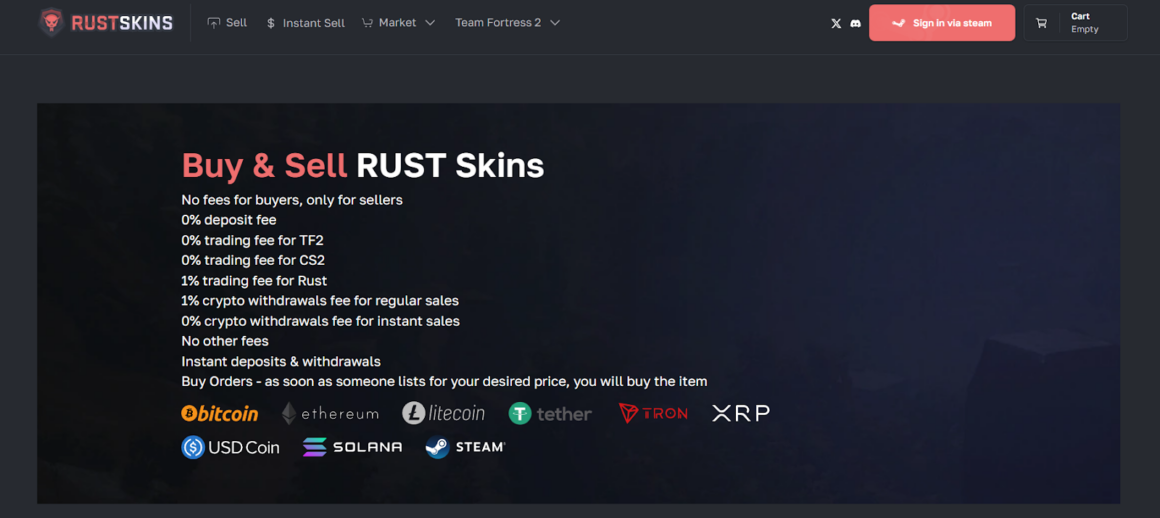
- RustSkins: A powerhouse for high-volume traders. RustSkins uses a distributed ledger system and offers some of the lowest fees in the industry (often around 3-7% depending on the item and promotional periods). They are aggressive with Cryptocurrency integration, making them a favorite for global sellers.
- SkinBaron: Based in Germany, this is the “old guard” of the European market. It is highly regulated and incredibly safe, though their 15% fee (which can be negotiated down for high-volume partners) is on the higher side. It is the go-to for traders who prioritize SEPA bank transfers and legal transparency.
- CS.Trade & Tradeit.gg: These are “Instant Sell” sites. You will get less value here (often 20-30% below market), but the money is instant. These are best used when you need to liquidate inventory immediately to catch a dip on another platform.
The Fee Matrix: Protecting Your Margins
In the world of Rust trading, a 5% difference in fees can be the difference between a profitable month and a net loss. When choosing your infrastructure, you must calculate the “Total Friction Cost.” This isn’t just the seller fee; it includes:
- The Listing Fee: What the site takes when the item sells (e.g., 5%).
- The FX Fee: If the site operates in USD but your bank is in EUR or UAH, you may lose 2-3% in currency conversion.
- The Withdrawal Fee: Some sites charge a flat $2 fee for bank wires, while others take 1% for Crypto payouts.
Withdrawal Ecosystems: How You Get Paid
The “Real Money” aspect of the strategy depends entirely on the “Off-Ramp.” You must align your platform choice with your banking capabilities:
- Traditional Banking (SEPA/ACH): Best for large, infrequent withdrawals. It’s slow (2-5 business days) but provides a clear paper trail for tax purposes.
- Cryptocurrency (BTC/LTC/USDT): The fastest and most flexible. Sites like RustSkins allow you to go from “Sold Item” to “Crypto in Wallet” in under an hour. This is vital for “re-investing” capital quickly.
- E-Wallets (Payoneer/Skrill): A middle ground, offering faster speeds than banks but with higher internal fees.
Traffic and Liquidity
A marketplace is a ghost town without buyers. You might find a niche site offering a 0% seller fee, but if your LR-300 skin sits there for three months without an offer, your capital is “dead.”
High-velocity markets (Skinport, RustSkins) allow you to flip items 5-10 times in the time it takes to sell one item on a low-traffic site. In the Rust economy, where skin prices can shift 15% based on a single “Twitch Drops” announcement, the ability to sell now is often more valuable than a low fee.
The “Buy Low” Strategy
The art of the “buy-in” is where the most successful Rust liquidators separate themselves from the casual gamers. To generate real-money returns, you have to stop viewing skins as cosmetic upgrades and start viewing them as a fluctuating commodity. Sourcing is the foundation of your profit margin; if you buy at the wrong price, no amount of marketing will save your ROI.
The Thursday Liquidity Crunch
The Rust economy operates on a weekly heartbeat dictated by the Facepunch store refresh every Thursday (typically 20:00–21:00 UTC). This is the most critical window for any serious seller. When a high-tier set, like the “Blackout” or “Whiteout” series, receives a new addition, a “Capital Flight” occurs across the secondary markets.
- The “Desperation Discount”: Thousands of players who are “inventory rich but balance poor” suddenly need liquid funds to buy the new store items. To get those funds instantly, they dump their existing skins on third-party sites like Skinport or RustSkins, often listing them at 10–15% below the current market floor just to ensure a “top-of-list” sale.
- The 48-Hour Sniping Window: From Thursday evening to Saturday morning, the market is flooded with undervalued “liquid” items. A professional strategy involves maintaining a “war chest” of liquid balance specifically for these 48 hours. By sweeping up standard-issue gear (like Roadsign Gloves or Small Wood Boxes) during this dip, you are essentially buying discounted currency that will rebound to its baseline value by Tuesday. Even small boosts to your balance can make these trades more impactful; using a Rainbet referral code, for example, can provide extra credits or bonuses on your first deposit, giving you more firepower for these high-opportunity weekend windows.
Strategic Asset Allocation
Your inventory shouldn’t be a random collection; it should be a balanced portfolio divided by its “Exit Velocity.”
- High-Yield “Blue Chips” (The Real Estate): These are items with Functional Scarcity, skins that offer a tangible gameplay advantage, such as the Big Grin (conceals the head in shadows), the Alien Relic SMG (glowing iron sights), or the Glory AK47. These skins are the “Gold Standard” of Rust. They are highly resistant to market crashes and tend to appreciate over long cycles. Sourcing these requires a “Sniper” mindset: you are looking for “distressed” listings where a high-volume collector is cashing out their entire inventory and is willing to take a 5% haircut for a bulk sale.
- High-Velocity “Liquids” (The Currency): Items like the Arctic Suit, Blackout Hoodie, or Forest Raider Pants move hundreds of units per day. These are your “Cash Equivalents.” You don’t buy these for a 50% “moonshot”; you buy them for a consistent 5–8% “flip.” The goal is to keep your capital moving. If your money is sitting in a rare, $500 skin that takes three weeks to sell, it’s “dead capital.” High-velocity items ensure that your bankroll is constantly turning over, compounding your profits weekly.
Exploiting Inter-Market Arbitrage & Inefficiencies
The Rust market is fragmented. Unlike a centralized stock exchange, Rust skins are traded across dozens of independent platforms that do not always sync in real-time. This creates Arbitrage Gaps.
- The Bot vs. P2P Lag: Bot-based markets (where the site holds the skin) often have rigid pricing algorithms. Peer-to-Peer (P2P) markets (where players hold the skins) are driven by human emotion and urgency. It is common to find a skin on a P2P site listed for $40 because a single user is in a rush, while the “Instant Buy” price on a Bot site is $46.
- The 7-Day Trade Lock Factor: Many traders fear the 7-day trade lock. You can exploit this fear. Items that are “Trade Locked” on a marketplace often sell at a slight discount compared to “Tradable” items. By sourcing skins that have 5–6 days left on their lock, you are essentially buying at a discount in exchange for a few days of patience. Once that lock expires, the skin’s value instantly jumps back to the “Tradable” premium.
Speculative “Set Completion” Sourcing
Rust players are completionists. When a new piece of a legendary set is released, the “legacy” pieces of that set invariably skyrocket.
- The “Forest Raider” Effect: If a “Forest Raider” chest plate is leaked or approved in the Steam Workshop, the existing “Forest Raider” leggings, which may have been stagnant for months, will see a massive spike in demand as players rush to complete the full camouflage look.
- The Workshop Watch: Professional sourcers spend as much time on the Steam Workshop as they do on the marketplaces. By tracking which skins are receiving “Developer Upvotes” or high community engagement, you can front-run the market. Buying the “base” pieces of a set before the expansion is officially added to the store is one of the most reliable ways to secure a 30–50% ROI in a single week.
Maximizing Profits and Selling Tactics
Once you’ve successfully sourced your inventory, the focus shifts to the “exit”, the moment you convert digital pixels into realized profit. Maximizing your return in the Rust market requires a departure from the “set it and forget it” mentality. In 2026, the difference between a 5% and a 20% margin often comes down to how you manipulate liquidity and time your listings against the game’s internal and external events.
Timing the Market: Capitalizing on the Player Pulse
The Rust economy is directly tethered to player activity and “hype cycles.” Unlike more static markets, skin prices in Rust react violently to the game’s schedule.
- The “Forced Wipe” Spike: On the first Thursday of every month, all official servers undergo a “Forced Wipe.” This is the peak of player engagement. Thousands of players return to the game simultaneously, all wanting to start their new wipe with a fresh look. If you list your high-demand items, especially glowing doors and building skins, 24 to 48 hours before the wipe, you can often command a 5–10% premium. Buyers are less price-sensitive when they are in a rush to gear up for a new server start.
- Twitch Drops and FOMO Pricing: Twitch Drop events (like the “Home Brewed” series in early 2026) act as massive marketing campaigns for the game. These events bring in a wave of casual players who see high-tier skins on their favorite streamers’ screens. While the “Drop” skins themselves are untradable, the hype spills over into similar marketable skins. For example, if a popular streamer is using a specific camouflage set, similar “liquid” pieces in that color palette often see a 15–20% jump in trading volume. This is your window to exit positions that have been stagnant.
Pricing for Liquidity: The “1% Under” Rule
In a fragmented market, your greatest enemy is a “Price War.” Many amateur sellers see a competitor list an item for $50 and immediately list theirs for $45, triggering a race to the bottom that destroys everyone’s margins.
To stay at the top of the “Cheapest” list without crashing the market, use the “1% Under” Rule. If the lowest listing for a Large Box skin is $10.00, list yours at $9.90. This $0.10 difference is enough to trigger the sorting algorithms of most marketplaces (placing you at the very top of the search results) without signaling a “market crash” to other sellers. The goal is to be the first choice for the next buyer, not the cheapest by a mile. In the high-velocity world of 2026 trading, being $0.10 cheaper often results in a sale within minutes, whereas matching the price might leave you buried for days.
The Power of Buff163: The Invisible Hand
Even if you are cashing out on Western platforms like Skinport or RustSkins, your most valuable tool is Buff163. As the world’s largest skin marketplace, Buff163 dictates the “True Global Floor” for almost every digital asset in the Steam ecosystem.
- Real-Time Price Discovery: SCM (Steam) prices are often inflated by 15–30%. Buff163 prices represent the “Raw Value” of a skin. Before you list an item on a Western site, check the recent sales history on Buff. If the Buff price is rising, you should “overprice” your listing on Skinport and wait; the Western market usually lags behind Buff’s trends by 48–72 hours.
- Tracking Supply: Buff163 allows you to see the exact number of items currently listed globally. If you see the “Listing Count” for a rare item like the Big Grin dropping on Buff, it means the global supply is tightening. Instead of selling now, you can hold your listing for an extra week to capture the inevitable price hike on the more illiquid Western markets.
Risk Management & Security
Digital doorcampers, scammers and predatory bots, are constantly looking for a gap in your security to siphon off your inventory. As we navigate the 2026 market, risk management is no longer an optional safety measure; it is a core component of your profit margin. One hijacked trade can wipe out months of successful flips.
The Invisible Threat: API Scam Awareness
The most sophisticated and devastating scam in the modern era is the API Key Hijack. This isn’t a simple “give me your password” trick; it is a silent takeover of your trade permissions.
- How it Works: You visit a fake trading site or “prize” link and click “Sign in through Steam.” Instead of a legitimate login, you inadvertently grant the site permission to generate a Steam Web API Key on your account.
- The “Switch” Maneuver: From that moment on, a scammer’s bot monitors your account. The next time you send a legitimate trade to a marketplace bot or a friend, the scammer’s bot uses your API key to instantly cancel that trade and send an identical-looking offer to their own account. Because the avatar and name match perfectly, most users hit “Accept” on their mobile authenticator without realizing the recipient has changed.
- The Defense Protocol: Visit steamcommunity.com/dev/apikey regularly. If you see a key listed that you didn’t personally create for a specific, trusted tool, revoke it immediately.
Identifying Phishing Sites: The Red Flags of 2026
Phishing has evolved beyond poorly spelled emails. Scammers now use Search Engine Ads to place fake versions of popular sites like Skinport or RustSkins at the very top of Google results.
- URL Deception: Look for “Homoglyphs”, characters that look identical but are technically different. A site might be skínport.com (using an accented ‘i’) or steamcornmunity.com.
- The “Double Login” Trap: If a site asks you to enter your Steam Guard code and then immediately says it was “incorrect” or asks for it a second time, close the tab. They are likely using the first code to change your account details in real-time.
- The Discord/Admin Myth: No legitimate marketplace admin or Valve employee will ever contact you via Steam Chat or Discord to “verify” your items or investigate a “pending report.” If someone asks you to send your items to a “storage bot” for safety, they are 100% trying to raid your inventory.
The 7-Day Trade Lock: Factoring Time-Decay into ROI
The “Trade Lock” is the invisible tax on your capital. When you buy or trade for a Rust skin, it is typically locked to your account for seven days. This is a security feature to prevent scammers from quickly “laundering” stolen goods, but for a seller, it creates Time-Decay Risk.
- The Opportunity Cost: Your money is “dead” for 168 hours. If you buy a skin for $100 hoping to flip it for $110, but the market price drops to $95 by the time the lock expires, you’ve lost money.
- Pricing for the Future: When sourcing inventory, you shouldn’t price based on today’s value, but on the projected value in seven days.
- Liquidity Strategy: Always keep at least 30% of your inventory in “Unlocked” state. This ensures that if a major market shift happens, you have assets you can move immediately to cut losses or pivot to a new trend.
Conclusion
The path to profitable skin selling in Rust is paved with discipline, security, and a deep understanding of market cycles. By shifting your perspective from a casual player to a strategic seller, you can transform a digital inventory into a consistent real-world revenue stream. Success in this space isn’t about landing a single “lucky” drop; it’s about the compounding effect of minimizing marketplace fees, sourcing during the Thursday liquidity crunches, and protecting your assets from the ever-present threat of API scams.
Ultimately, the most successful traders are those who prioritize liquidity and timing over raw price tags. By leveraging the global pricing data of Buff163 and aligning your sales with the game’s monthly forced wipes, you ensure your capital is always moving rather than sitting stagnant in a trade-locked inventory. As the Rust economy continues to evolve, staying informed on these foundational strategies will ensure that your “Island” profits remain secure and scalable for years to come.